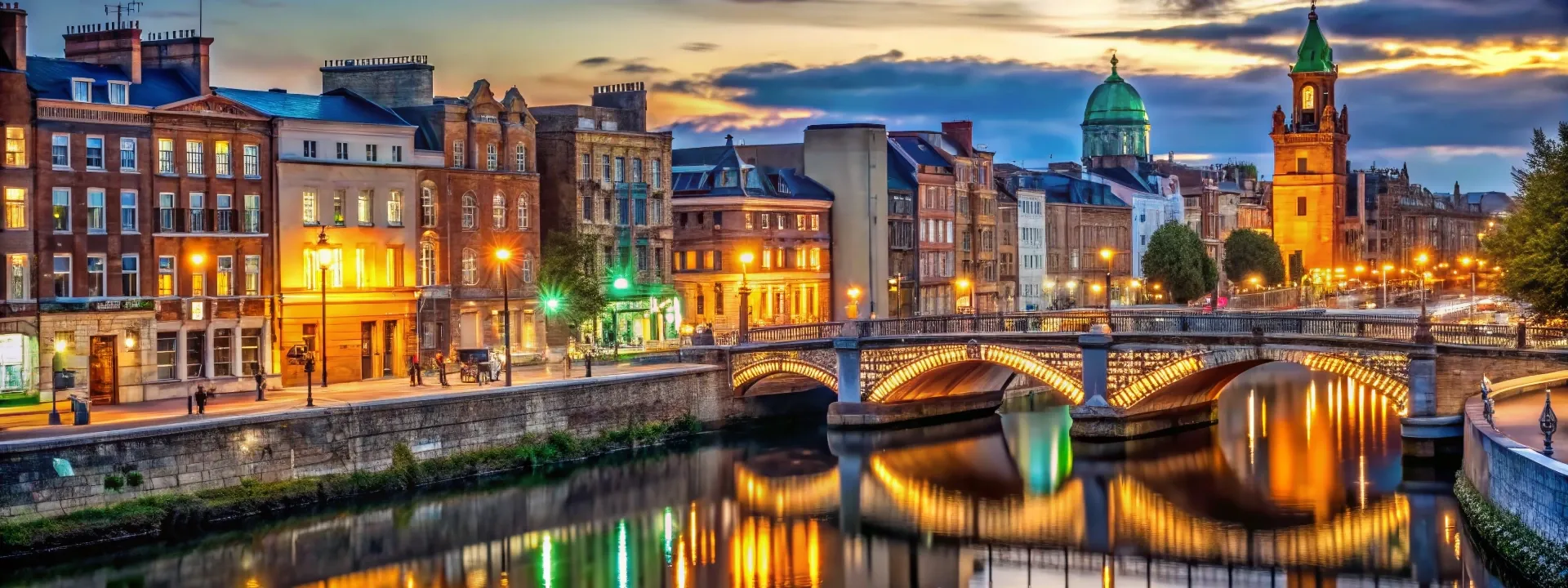
Ireland has become a preferred study destination for international students due to its globally ranked universities, strong industry connections, and welcoming student environment. Explore everything about studying in Ireland, including universities, courses, scholarships, student visas, and career opportunities.
Europe’s fastest growing economy
Ranked #10 Globally for High-Quality Scientific Research
Ranked as the 13th most peaceful place on Earth
All Universities Globally Ranked among top 5%
Among the top 20 education systems worldwide
Post Study Work Visa up to 2 Years
Discover leading universities in Ireland that offer internationally recognised degrees, research-driven learning, and excellent graduate employability across a wide range of disciplines.
Explore highly demanded courses in Ireland such as business analytics, computer science, pharmaceuticals, engineering, healthcare, finance, and digital marketing that align with global industry needs.

Understand the tuition fees and living costs in Ireland, including accommodation, transportation, food, and other student expenses to help you plan your study abroad budget wisely.
Find scholarships and funding opportunities available for international students in Ireland, including government funded, university-specific, and merit-based scholarships.
Learn about the major intake seasons in Ireland universities and colleges, application timelines, and the best intake to start your academic journey in Ireland.
September
January to February
April
Check the admission eligibility for undergraduate and postgraduate programs in Ireland, including academic qualifications, English language scores, and course-specific requirements.

Know the entrance and English language proficiency requirements accepted by universities in Ireland for international admissions.
Understand Ireland's university admission requirements and prepare a strong application for your preferred course and institution.
Proof of your English language proficiency through tests like IELTS, TOEFL, PTE, or Duolingo, required for admission and visa applications.
A collection of your work showcasing your skills, creativity, and achievements. A portfolio is required only for design-related programs.
Learn everything about the Ireland student visa process, required financial documents, visa fees, processing timelines, work permissions, and the student insurance services we provide for international students.
Ireland offers excellent post-study work opportunities and access to top multinational companies. Explore career prospects, average salaries, and work opportunities after studying in Ireland.
Note: - These figures are indicative and may vary as per the industry norms.

Explore the best cities in Ireland for students, known for quality education, cultural experiences, student-friendly lifestyles, and strong employment opportunities.
Get quick insights into student life in Ireland through engaging reels and short updates covering universities, scholarships, accommodation, and career opportunities.

Take inspiration from students who secured admissions to top Ireland universities and successfully began their international education journey.
University College Dublin
Sept 2025
University of Galway
Sept 2025
University College Dublin
Sept 2025
University of Limerick
Sept 25
University College Cork
Sept 25
University of Galway
Sept 25
Maynooth University
Sept 25
National College of Ireland
Sept 25
National College of Ireland
Sept 25
Dublin City University
Sept 25
KC provides expert guidance for students planning to study in Ireland, from university shortlisting and applications to visa assistance and scholarship support.
Fun Fact: Ireland is called the Silicon Valley of Europe, an epithet it received for hosting the headquarters of numerous industry-leading companies and multinational corporations. This strong presence of global employers, combined with a world-class education system, has made the Emerald Isle a highly sought-after study abroad destination in 2026-27. Among the other reasons to pursue higher education in Ireland are its internationally recognized universities, boasting high academic standards and a safe & welcoming environment.
In fact, Irish Institutions strongly emphasize student well-being, offering comprehensive support services, academic & career support, and much more. All these aspects help international students smoothly integrate into the Irish student community and campus life. Whether they are studying in the bustling cities or in smaller student-friendly towns, students will find a supportive environment that fosters personal and professional development.
So, if you are eager to learn more about the life of international students in Ireland, this article is the only guide you need. Here, we have outlined various aspects of your academic journey to paint a clearer picture and help you make informed decisions.
Table of Content
| Aspect | Highlights |
| Education | Globally recognized degrees with strong industry relevance |
| Safety | Safe, welcoming, and student-friendly country |
| Language | English-speaking environment for easy communication |
| Diversity | Multicultural campuses with students from around the world |
| Part-Time Work Rights | Up to 20 hrs/week during term and 40 hrs/week during holidays |
| Post-Study Work Visa | 2 years (Masters) & 1 year (Bachelors Honours Degree) |
| Career Prospects | Strong opportunities in IT, Healthcare, Finance, Engineering, & Pharma |
| Student Life | Vibrant Campus Culture with Clubs, Sports, & Events |
| Travel | Easy & Affordable access to Europe |
| Living Standards | High Quality of Life Supported by Excellent Public Services |
As mentioned earlier, Ireland has emerged as a popular destination to pursue higher education in recent years. This popularity stems from the country’s unique blend of academic excellence, high quality of life, career opportunities, and cultural diversity. Its inclusivity, especially towards international students, makes the transition easy for them.
Let us take a quick look at the factors that make the life of international students attractive in Ireland.
While Ireland offers an exciting environment beyond the classroom, studies remain the primary reason for this journey abroad. Understanding the style of teaching, academic expectations, and assessment methods can help students prepare for success from the get-go, as outlined in the next section.
The academic life of an international student in Ireland is designed to encourage independent thinking, creativity, and practical problem-solving over rote learning. Universities focus on preparing them for a global career through research, innovation, and industry collaborations. Irish Universities’ curriculum includes projects and assignments on real-world issues. These incorporate skills relevant to the job market and highly valued by employers. Let us get a quick glimpse of the academic aspects.
While studies are important, a productive academic experience depends on comfortable, convenient accommodation. Yes, choosing the right place to live can significantly impact both academic and overall student experience, which we will explore further.
Finding suitable student accommodation in Ireland is one of the first priorities for international students after receiving the letter of acceptance from prospective Irish Universities. Ireland offers varied housing options, catering to different budgets, lifestyles, and preferences. While university-managed types offer convenience and proximity to the campus, private accommodations provide flexibility.
Here are the most popular types of housing options.
Due to increasing demand, international students are advised to begin researching accommodation options before arriving in Ireland. They need to consider various factors, such as checking for affordable cities to study in Ireland, as the rental costs, including amenities, can be challenging to manage. Another major aspect to assess while comparing housing options is transportation.
Ireland offers a robust and convenient public transport system, connecting universities, residential areas, and major cities. International students can opt for buses, trains, trams, cycling, or walking, depending on the location and daily commuting time. Irish Public Transportation is generally very reliable, offering student discounts through Student Travel Cards. Many universities feature pedestrian-friendly infrastructure, encouraging walking as a general mode of commute.
Let us explore all the options through the list below.
The Student Leap Cards offer up to 30% discounts on each ride, helping students save on transport costs. Speaking of expenses, transportation makes up only a small portion of those. To plan finances properly, it is essential to understand the overall cost of living in Ireland.
An important factor to consider while studying in Ireland is the overall cost of education. It comprises tuition fees and living costs in Ireland, both of which vary depending on the prospective institution, course, and lifestyle. In fact, living expenses comprise various aspects, and keeping track of them allows a smoother educational experience. Let us take a quick look at the all-encompassing factors.
| Expenses | Average Annual Estimated Cost |
| Housing Rent | €7,000 - €9,600 |
| Food & Groceries | €2,400 - €3,000 |
| Transport | €600 - €900 |
| Utilities | €600 - €900 |
| Entertainment | €600 - €900 |
| Study Material | €300 - €500 |
| Miscellaneous | €300 - €1,200 |
After budgeting for rent and transportation, food becomes another important aspect of the everyday life of an international student in Ireland. Knowing where to shop and what to expect can help them spend smartly, so let’s have a look at the what and how of food and other daily essentials for a budgeted lifestyle.
Ireland offers a diverse culinary scene that reflects its multicultural population. It’s easy to find international cuisines, affordable supermarkets, and speciality grocery stores catering to different preferences. Whether the plan is to cook at home or dine out occasionally, there is a favorable option for every budget. Managing daily routines becomes easier with proper planning. Let us dive into it right away.
While managing daily expenses through the above-mentioned budgeted options, international students can also look for ways to earn while pursuing studies in Ireland. A good way to do so is through Part-Time work opportunities, which offer both financial aid and valuable work experience during studies. Read on to find out more about it.
Part-Time work is a popular option that helps cover living expenses. It opens opportunities to build networks and understand Irish culture. However, maintaining a healthy balance between work and academics remains essential. Moreover, universities often provide career support and job portals to assist in finding suitable roles. The most common job roles include:
Beyond academics and employment, the university life of international students in Ireland is equally about building friendships, exploring interests, and creating memorable experiences. Next up, we will explore these aspects.
Student life in Ireland extends far beyond classrooms, where universities encourage participation in clubs, societies, sports teams, and more. These experiences help develop confidence, communication skills, and lifelong friendships. Ireland’s lively music scene, festivals, and social events create an enjoyable atmosphere throughout the academic year. Students can also spend time exploring nearby attractions or participating in campus events. A balanced lifestyle contributes positively to academic success. Moreover, active participation in various events helps them feel more connected to their university community.
They can do so through:
As international students settle into their routines, adapting to Ireland’s climate becomes another important aspect of everyday life. Preparing for seasonal weather can make daily living much more comfortable. Head over to the next section, where we have outlined the weather and lifestyle adjustments needed to study in Ireland.
Ireland experiences a temperate climate characterized by mild temperatures and frequent rainfall year-round. The country’s weather is unpredictable, with sunshine and rain occurring on the same day. Although winters are cold, they are generally milder than those in many other European Countries. Staying active and maintaining a routine will help international students adapt comfortably. Preparing for the weather ensures a more enjoyable experience throughout the year. Let us take a look at a few tips to keep in mind.
Adjusting to a new country involves more than adapting to the weather. Maintaining health is equally important for academic success.
Maintaining good health is essential for making the most of one’s experience while studying in Ireland. Irish Universities provide various support services, including medical centers, counselling services, wellness workshops, and mental health resources.
Here are the well-being resources which international students can check for based on the need.
Good health and academic success naturally leads towards a long-term goal. Building a supportive social circle also contributes significantly to emotional well-being. This also helps build a successful career, which we will see in the subsequent section.
As mentioned earlier, Ireland has established itself as one of Europe’s leading employment destinations for graduates across multiple industries. Irish Universities maintain strong collaborations with employers, helping students gain internships, placements, and networking opportunities during their studies. Let us explore the career development and support activities across Irish Institutions.
These are a few aspects in which the Irish universities support students helping them connect with the right prospective employer. Developing professional skills early greatly improves employability prospects after graduation. Furthermore, making the most of the opportunities requires thoughtful planning and proactive decision-making throughout the academic journey.
In short, studying in Ireland offers far more than an internationally recognized qualification; it provides an opportunity to experience a welcoming environment. But planning for it without any hassle may require professional consultation, which is where KC Overseas can be of great help. Our Ireland Experts offer end-to-end assistance from shortlisting universities and courses to applications, visa, and student accommodation. Our team also offers other allied services support a seamless, hassle-free experience.
Ireland offers several student cities, each with its own unique perks. They include cities such as Dublin, Cork, Galway, Limerick, and Maynooth. But the best city ultimately depends on preferred university, lifestyle, and budget.
Yes, family members and friends can visit students in Ireland, provided they meet the immigration requirements. They may need to apply for a short-stay (tourist) visa and comply with the conditions of their stay.
Although not mandatory, it is recommended to open an Irish Bank account to receive wages and have seamless services. Many banks offer student accounts with reduced maintenance fees, and universities often provide guidance on the documents required.
Ireland has several reliable networks offering both prepaid and postpaid plans. Students may need to research the best provider, based on the city they live in and their usage.
The International Student Identity Card (ISIC) is a globally recognized student ID card. It provides access to thousands of discounts and benefits in Ireland. Carrying it with them reduces everyday expenses while studying abroad, although eligibility and available offers may vary by location.
Aug 10, 2026
In the academic year 2024-2025, the international student enrolment for higher education in Ireland reached a record high of 44,500. This amounted to a 10% increase over 2023-2024 enrolments, which were 40,000. This is when you know the gold is where the crowd is heading.
As the global education landscape undergoes major shifts, students are increasingly seeking a stable, more affordable, high-quality education. This is where Ireland shines, not just as an alternative to popular destinations, but as an active first choice for informed students. Where other destinations promise a world-class degree and job prospects, Ireland goes beyond. Unlike other European countries where language is a constraint, Ireland offers English-language research-based education within the European Union, placing the graduates at the intersection of global commerce.
Among all the degree programs you can choose from to study in Ireland, an MS in Ireland is certainly the better option. This article will unravel all aspects of studying an MS in Ireland, from universities and courses to costs and more. But first, let’s check out the highlights.
Table of Content
| Factors | Details |
| Total Universities | Total 13 universities:
|
| Popular Specializations |
|
| Intakes |
|
| Language of Instruction | English |
| Average Annual Cost of Education |
|
| Average Annual Pay Packages |
|
Now that we have a complete roadmap in front of us, we will proceed to the next stage of the journey: understanding the benefits of pursuing an MS in Ireland.
The MS in Ireland degree is among the most wide-ranging postgraduate programs. As a result, it is among the most in-demand programs for studying abroad. This is especially true for Ireland, whose economy is built around science-driven industries.
Here are all the unparalleled benefits you will get when you choose to study an MS in Ireland.
Not to mention, Ireland is also known for its safe, student-friendly environment both on and off campus. Several Irish universities have vibrant student communities and multicultural campuses, fostering an inclusive environment.
While the benefits are appealing, what gives them volume is the universities that strive to provide world-class education, foster high-impact research, and ensure the students are prepared for the dynamic global job market. In the next section, you will read which universities these are.
Irish universities are renowned for their strong academic quality, providing industry-aligned and research-driven education at all levels, especially for MS programs. As a result, the country is now ranked 10th in the World's Best Education Systems, making it among the most educated countries in the world.
Here are the top universities in Ireland offering the best MS programs, along with their popular specializations.
| Universities | Top MS Specializations |
| Traditional Universities | |
| Trinity College Dublin | Computer Science, Data Science, Artificial Intelligence, Finance, Biomedical Engineering |
| University College Dublin | AI & Machine Learning, Business Analytics, Cybersecurity, Biotechnology, Finance |
| University College Cork | Pharmaceutical Sciences, Cybersecurity, Food Science, Data Science, Engineering |
| University of Galway | Computer Science, Biomedical Engineering, AI, Biotechnology, Business Analytics |
| University of Limerick | Software Engineering, Robotics, Mechanical Engineering, Data Analytics, Supply Chain Management |
| Dublin City University | Computing, Cybersecurity, AI, Electronics, Digital Marketing |
| Maynooth University | Data Science, Computer Science, Business Analytics, Finance, Climate Science |
| Technological Universities | |
| Technological University Dublin | Cloud Computing, Cybersecurity, Computing, Construction Management, Engineering |
| Munster Technological University | Cybersecurity, Software Development, Pharmaceutical Biotechnology, Engineering |
| South East Technological University | Data Analytics, Pharmaceutical Science, Computing, Engineering, Business |
| Atlantic Technological University | AI, Computing, Medical Technology, Environmental Science, Engineering |
| Technological University of the Shannon | Applied Software Engineering, Robotics, Data Analytics, Mechanical Engineering |
| Specialized University | |
| RCSI University of Medicine and Health Sciences | Biotechnology, Pharmaceutical Sciences, Clinical Research, Healthcare Management, Biomedical Sciences |
Studying for an MS in Ireland at one of these universities sets you on the path of continuous growth and career advancement, making your investment extremely worthwhile.
However, before we discuss returns, it is important to know how much you need to invest. This takes us to understanding the cost of education.
While Ireland takes pride in providing an education of the same quality as the Big 4, it also takes pride in keeping it highly accessible to international students. Compared to other English-speaking education destinations, Ireland is often regarded as one of the most affordable.
Don’t just take our word for it; read the annual estimate of cost to study in Ireland in the table below and see for yourself.
| Expense Category | Estimated Annual Cost (EUR) |
| Tuition Fees | EUR 11,300 – EUR 34,500 |
| Living Costs | EUR 12,000 – EUR 18,000 |
Please note that these are estimates, and the actual cost can vary based on the university, city, accommodation type, and lifestyle choices. However, the costs give you an idea of how to plan the finances.
While learning the costs is one aspect of financial planning, another important aspect is to understand the timeline. For this, you need to know the intake windows during which applications are accepted, which we will cover next.
As a popular destination, Ireland receives a large number of student applications from around the world. Hence, intake for MS in Ireland is held twice a year. This gives students enough time to plan and target the right intake for their course, and the universities to analyze the applications properly.
Here are the two main intakes.
Depending on when you want to apply, take education loans, and complete visa formalities, you can choose the intake that best suits you. Students can plan between Autumn and Spring intakes, depending on preparation timelines and course availability, and use the gap strategically. After addressing when to apply, it is also crucial to know what makes you eligible to apply for an MS in Ireland.
To analyze whether a student is eligible to pursue education in the Irish education system, universities set criteria for every student. These criteria mainly comprise previous academic records and English proficiency scores, as it is the main language for the curriculum and the country. Check out the detailed criteria for the MS in Ireland in the table below.
| Eligibility Aspect | Requirement for MS Program |
| Education Requirement | Minimum 55%-75% in Graduation |
| English Proficiency Test |
|
Please note that although the Irish universities use the NFQ Level 9 framework for MS degree programs, eligibility criteria may vary across institutions. Factors affecting eligibility criteria include the university's admission standards, the course's competitiveness, and the requirement for a standardized test.
Therefore, before you apply, thoroughly review the criteria and ensure you have all the required documents to prove your eligibility. Speaking of which, the next section will explore the documentation requirement in detail.
As Irish university applications are screened digitally, you need to ensure that no documents are missing, to avoid delays in the application. Therefore, we have provided a comprehensive list of the documents you need to prepare for MS in Ireland.
Before you go to the university portal to submit the application, make sure to check the specific requirements and fulfill them well before the application date. Every Irish university has its unique online application portal, which gives you a unique advantage of tailoring your SOPs to target the specific university and enhance the chances of approval. But this also means you need to keep in mind the unique application process for each.
After this, your education journey finally begins. Upon completing your education, you can begin to see the results of your hard work in the excellent job prospects the country offers.
While Ireland surpasses expectations as a world-class education destination for an MS degree, it doesn’t stop there. Education is only valued when it yields better returns. The country recognizes this and thus offers excellent job prospects for science graduates.
The table below gives a bifurcation of sectors with their job roles and estimated base pay after studying an MS in Ireland.
| Sectors | Job Roles | Estimated Annual Base Pay (EUR) |
| Technology | Software Engineer | EUR 57K – EUR 84K |
| Cybersecurity Analyst | EUR 40K – EUR 62K | |
| Cloud / DevOps Engineer | EUR 50K – EUR 75K | |
| IT Project Manager | EUR 55K – EUR 76K | |
| Pharma & Life Sciences | Quality Control Analyst | EUR 35K – EUR 44K |
| Regulatory Affairs Specialist | EUR 38K – EUR 60K | |
| Clinical Research Associate | EUR 38K – EUR 49K | |
| Pharmaceutical Scientist | EUR 49K – EUR 54K | |
| Finance & FinTech | Financial Analyst | EUR 33K – EUR 55K |
| Risk Manager | EUR 35K – EUR 72K | |
| Investment Analyst | EUR 30K – EUR 58K | |
| FinTech Product Manager | EUR 61K – EUR 90K | |
| Engineering | Automation Engineer | EUR 44K – EUR 65K |
| Mechanical Engineer | EUR 38K – EUR 55K | |
| Electrical Engineer | EUR 45K – EUR 65K | |
| Process Engineer | EUR 41K – EUR 58K | |
| Data & Analytics | Data Scientist | EUR 47K – EUR 75K |
| Business Analyst | EUR 38K – EUR 60K | |
| Big Data Engineer | EUR 57K – EUR 81K | |
| Analytics Consultant | EUR 50K – EUR 58K | |
| Healthcare | Public Health Analyst | EUR 48K – EUR 55K |
| Healthcare Data Analyst | EUR 44K – EUR 65K | |
| Health Informatics Specialist | EUR 32K – EUR 40K | |
| Medical Science Liaison | EUR 60K – EUR 81K |
In conclusion, studying in Ireland can become one of the most rewarding milestones of your academic and professional journey. However, this decision involves much more than just choosing the university and planning finances. You also need to understand the finer details of student visas, part-time work rights, accommodation, scholarships, post-study work opportunities, and much more.
This is where KC Overseas Education comes in. From selecting the right universities to assisting with applications, education loans, and every aspect, our experts are here to guide you at every step. With the right support and preparation, your dream can become a life-changing opportunity.
For courses lasting longer than 90 days, the Long-Stay Visa (D Visa) is the permit you need. It is valid for the entire duration, and the stay permission is granted for 12 months at a time, which can be renewed for up to 7 years.
The Ireland student visa application fees depend on whether you apply for a single-entry or multiple-entry visa.
Dublin is the capital and economic hub of Ireland, so it’s the most expensive. Limerick, Waterford, Galway, and Cork are among the most affordable cities.
The minimum proof of funds requirement is EUR 10,000 per subsequent year of your studies, plus the course fees for that year.
You need to apply for either a Critical Skills Employment Permit or a General Employment Permit, depending on your salary after your post-study work permit ends and you have secured a job. Once the application is approved, your immigration status typically changes to Stamp 1.
Jul 27, 2026
Technology has been intrinsically embedded in the very fabric of life. The increasing reliance on technology paved the way for the rapid advancement of Artificial Intelligence, Machine Learning, Cloud Computing, and Big Data. This, in turn, made the studies of Computer Science more relevant now than ever. Today, it is one of the most in-demand fields of study in higher education, promising great global job prospects and future career security.
Computer Science is a field that not only keeps students ahead of the competition but also equips them with the skills that will remain relevant for a lifetime. It is especially rewarding when students choose to pursue an MSc in Computer Science in Ireland. Dubbed the Silicon Valley of Europe, Ireland is one of the best destinations to pursue a master's degree in Computer Science. Combining academic rigor with massive professional advantage, Ireland offers world-class universities, cutting-edge research opportunities, and a thriving technology ecosystem. All this at an affordable price.
Consider this article your beginner's guide to MSc in Computer Science in Ireland. Here we will explore the benefits, universities, costs, and career paths after education. Let us begin with a quick overview of the highlights.
Table of Content
| Factors | Details |
| Top Universities | 13 Total Public Universities and Technological Universities across Ireland |
| Popular Specializations |
|
| Intakes |
|
| Language of Instruction | English |
| Average Annual Cost of Education | EUR 18,000 - EUR 31,780 |
| Average Annual Pay Packages ( Freshers to Experienced Range) |
|
In the 2024/25 academic year, Ireland saw a record-high of 44,500 international student enrolments, exceeding the previous year’s total of 40,000, as per the data by the Higher Education Authority. Among all courses, STEM courses saw high demand, with a 65% surge in ICT programs.
There are several reasons for the increase in the popularity of the MSc in Computer Science in Ireland, and why you should choose it for your overseas education too.
In addition to these benefits, you gain an English language advantage, as Ireland is the largest remaining primary English-speaking country in the European Union. Plus, you get to enjoy a high quality of life and a welcoming environment. With these advantages in place, let us now take a closer look at some of the top universities offering MSc in Computer Science programs in Ireland.
With industry-focused curricula, strong university-industry collaborations, and a welcoming environment for international students, the universities in Ireland provide a launchpad for a global career in technology. Here are some of the notable names:
These universities are at the forefront of research and development in the country, and offer prestigious specializations, customizable & advanced programs, and industry-integrated coursework that combines Computer Science with Finance and Data Analytics. Leveraging their strategic location in Europe, they enable graduates to develop their expertise and industry experience.
To make their education more accessible, these universities offer highly affordable tuition fees for international students, which we will review in the next section.
Education is an investment for life. When it comes to studying abroad, the investment should be carefully calculated. This is why the cost of education is a necessary consideration. One of the major advantages of studying an MSc in Computer Science in Ireland is that the coursework is accelerated and lasts only 1 year. This ultimately reduces the overall cost of education, as you pay a lower tuition fee and manage living expenses for only a year before entering the job market. However, you still need to estimate the costs in advance to determine the education loan amount and additional expenses such as a student visa, accommodation, and transportation.
The table below provides an overview of the costs to make the work easier for you.
| Expense Category | Estimated Cost (EUR) |
| Tuition Fees | EUR 18,000 – EUR 31,780 per year |
| Living Cost | EUR 10,000 – EUR 15000 |
| D Study Visa (Long Stay Visa) |
|
| Accommodation Rent |
|
Please note that these are estimates and are subject to change. Tuition costs can vary based on the specialization, research requirements, and the university. Similarly, living costs can vary by city, accommodation type, and lifestyle choices.
Once you have planned your finances and how you will live in Ireland, the next step is to identify the optimal time to enter the country. This can be determined by learning about intakes.
There are mainly two intakes to study in Ireland for master’s degree admissions. These intakes are followed by most Irish Universities and Colleges for the MSc in Computer Science programs for almost every specialization.
Here is the detailed information for the intakes.
If you are planning to pursue an MSc in Computer Science and want the most options for specializations, it is recommended that you prepare for the September Intake and keep the January/February Intake as a backup option.
Based on the intake you choose, you can plan the entire timeline of your application, learn and meet the eligibility requirements, and prepare the documents. Speaking of which, next we will look at the eligibility requirements.
The eligibility criteria determine whether you are fit for the MSc in Computer Science in Ireland. Different universities may have different criteria; however, they are largely similar in academic requirements, English language proficiency, and prior coding experience.
Here is the eligibility requirement you need to satisfy to get selected in any of your chosen universities.
Several Irish universities offer conversion MSc programs that allow graduates from fields such as Mathematics, Physics, Engineering, and Statistics to transition into Computer Science without holding a bachelor's degree in the subject.
Meeting the eligibility requirements is only the first step. Once you have confirmed that you satisfy the criteria, you need to submit the supporting documents.
Documents help universities assess your academic background, professional achievements, and suitability for the program. Again, the documentation requirements can differ by university; the common requirements for prior academic records, standardized tests, and profiling are largely the same.
Here is the common documentation checklist:
Checking the university-specific document requirement is crucial to avoid any last-minute delays and the risk of application cancellations. Once you have carefully organized all the documents, you can confidently move on to the application process, as discussed in the next section.
The MSc in Computer Science program in Ireland operates on a rolling admissions basis. Therefore, international students are encouraged to apply as early as possible to improve their chances of admission and allow sufficient time for visa processing and securing scholarships in Ireland.
Most Irish Universities accept applications directly through their own online admissions portal, while some use a centralized application system called the Postgraduate Applications Center (PAC). In both ways, the application process is quite straightforward.
Since the application portals for different universities can differ, you need to navigate to the portal of each university website that you selected and learn their admission process. To apply via PAC, visit the PAC application portal to learn about the process.
Make sure you meet the eligibility requirements and have all necessary documentation before proceeding with the application process.
On the specific portals, including the PAC portal, you need to create an account with the necessary details.
Once you have created your profile, navigate to the application form, fill it out, and upload the required documents. Then you will be asked to pay the application fees. Give it one last check to ensure all the information is correct before submitting.
The university will take some time to review your application and may request additional documents during the process. Keep track of the entire process online and look out for any requirement emails.
Once the evaluation is complete, the university will issue either a Conditional offer letter or an Unconditional offer letter. You need to accept the offer letter and use it for the education loan and visa process.
Most Irish universities will require you to pay a tuition deposit to confirm your acceptance and secure your seat for the program.
After all these steps are complete, you can arrange the education funding and apply for the Irish Student Visa. Once you get the visa, you can finally book your tickets and fly to Ireland to pursue the career of your dreams.
Ireland is among the top destinations for those looking to launch an international career. It is called Silicon Valley of Europe for its strong tech ecosystem, globally leading multinational companies, access to the EU market, and global connectivity. From Google to Apple, Meta, Amazon, and more, you will find the headquarters of major IT firms all in one place. These companies actively seek international talent for Computer Science roles and promise a stable career.
Here is the overview of the job prospects after you graduate with an MSc degree in Computer Science.
| Criteria | Details |
| Top Recruiters |
|
| Job Roles |
|
| Average Annual Salary for Freshers | ~€35k–€55k
|
| Average Annual Salary for Experienced Professionals | ~€60k–€100k+
|
To make the job search easier after your graduation, you can leverage tools like LinkedIn, GradIreland, Indeed Ireland, IrishJobs, and University Career Hubs. These are the most widely used platforms for building professional networks and applying for jobs.
Now that you are well aware of what awaits you when you choose to study an MSc in Computer Science in Ireland, it is time to take the next step toward the future of your dreams. The journey is only fruitful when you take the first step right. This is possible when you make KC Overseas your study abroad partner. From the beginning, we support you with everything from searching for universities and meeting eligibility criteria to guidance on financing and the visa process. We make your dreams our mission. Reach out to us today and visit our website for more information.
With Stamp 2 immigration permission, you can officially work up to 20 hours per week during the semester and up to 40 hours per week, or full-time, during semester breaks, holidays, and vacations.
You can apply for the Post-Study Work Visa (Stamp 1G) once you get official written confirmation of your final degree results from your university.
It is recommended that you start looking for accommodation 4 to 5 months before your course begins. Apply early through the university portal to secure on-campus housing. Use well-known and trusted platforms such as Daft.ie, Rent.ie, Yugo, Aparto, or Facebook Groups to find suitable accommodation in Ireland.
It takes approximately 4-8 weeks for the Type D Long-Stay student visa in Ireland.
The typical proof of funds needed for an Ireland student visa is EUR 10,000 per additional year of study, plus the course fees for those years.
Jul 15, 2026
Studying overseas is a thrilling experience for many. Beyond just gaining world-class education and university facilities, many students are also excited about activities outside of academics, such as traveling, visiting museums, dining at a lavish restaurant, shopping, and more. However, most of the time, students have to pay for these activities out of their own pocket with their hard-earned part-time money, as using the living funds is not an option. Wouldn’t it be great to get discounts on travel and leisure activities?
If you have chosen Ireland as your study destination, then we have some great news. International students can use student cards to access discounts on everyday essentials and lifestyle services. In this article, we will explore all aspects of student cards in Ireland, including their types, uses, eligibility, and the application process. Let’s begin with a brief overview of the highlights.
Table of Content
| Aspects | Details |
| Applicability | To secure discounts on public transport, retail, entertainment, and others |
| Eligibility | Full-time enrolment at recognized second or third-level institutions in Ireland |
| Types of Student Cards |
|
| Cost (EUR) |
|
Now that we are on common ground, let’s unpack from here and understand what a student card in Ireland actually is.
Many students choose to study in Ireland for affordable education, world-class universities, access to the European job market, and an English-speaking environment. What makes studying and living here more satisfying is the student support services and benefits available across Ireland, one of which is the Student Card.
A student card in Ireland is the official student identification card that allows international students to verify their student status and get various discounts, concessions, and campus services. This card can be beneficial for international students in many ways, as explained in the next section.
Getting discounts on services and activities is not just about price; it is a more strategic way to manage expenses without sacrificing quality of life. No matter how much financial planning goes into studying abroad, actual living costs can still vary. Although many students choose to work part-time to manage unplanned extra costs, student discounts allow you to save some funds for a rainy day.
Here are all the strategic benefits that the Student Card in Ireland can give you.
What’s more? Some student cards can also work beyond Ireland, offering discounts on flights, hostels, and more.
While learning benefits truly spike the interest, it is important to know that not all the benefits are available on a single card. For different benefits, there are different types of student cards in Ireland.
There are three types of student cards available for international students studying in Ireland. These types differ based on their applicability and usage. Let's check them all out in detail below.
You can commonly use all three of these cards for different purposes to get the maximum student discounts on all activities. Now you can just focus on making memories while studying in Ireland without constantly calculating expenses on a notepad.
As the types change with the purpose, so do the eligibility requirements. Therefore, next, we will review the detailed eligibility requirements for the student card in Ireland.
Unlike student visa for Ireland and university applications, which require strict criteria for proof of funds, language proficiency, and course-specific requirements, eligibility for a student card is much simpler. The basic conditions for all student cards are similar, making it easier for international students to meet them.
To get a student card in Ireland, you must be:
If you check all the boxes, then you can confidently move on to the application process. But what is the good time to apply? Find out in the next section.
Since the student card in Ireland has limited validity from the day you receive it, the application timing must be accurate so you can take advantage of its benefits every day for the given period. As a result, the timing for the application matters.
A good rule of thumb for applying for a student card is:
The sooner you apply, the earlier you can begin enjoying its benefits. After answering the ‘when to apply?’ question, we will move on to ‘how and where to apply?’ for the student card.
Different types of student cards mean different application processes which is why it is essential to understand each application process separately. Below is the detailed step-by-step application process for each card.
After completing the steps, you will officially own a student card in Ireland, marking the beginning of a more financially sustainable and self-sufficient student journey in Ireland. The list of discounts you can take is endless, but how can you use them effectively?
Student cards are helpful, but what makes them the most useful is the strategies you apply to use them to the fullest. Here are those strategies you need.
You must apply for discounts everywhere you can directly at checkout with a Student Leap Card, College ID, and an ISIC card. Always ask, “Do you offer a student discount?” at stores, gyms, cinemas, and travel providers.
Student discounts are the most useful in everyday spending. You can use an ISIC Card and a College ID for fast food, cafes, groceries, clothing, and some apps and food services. The more you use it, the more savings will add up over a month.
Many cinemas, museums, attractions, and entertainment venues offer student discounts. Check individual providers for availability and terms. With an ISIC card and a College ID you can save on entertainment and membership costs. Show it at the entry of museums, amusement parks, attractions, etc. to get reduced or free entry. Check the student pricing on weekends.
Whether you are traveling by public bus, DART suburban trains, Irish Rail, Bus Éireann, or Luas tram, your Student Leap Card will be most useful for this.
You can avail of discounts on hostel and accommodation rent through student cards in Ireland. Even a small reduction can make a lot of difference.
The ISIC digital app will help you search for nearby discounts. Browse them before planning your outings to make the most of it.
Look out for ongoing deals and sales at nearby stores, malls, and online apps to stack up the benefits with sale prices, discounts, cashback, and loyalty points.
One card will not work universally. As the Student Leap Card is for travel, the ISIC card is for international student offers, and the College ID is for university facilities and local businesses, you should carry and use them as needed.
Taking advantage of student discounts is a practical way to manage living expenses while studying abroad; it is a smart step toward saving, being financially responsible, and being conscious of your spending. It is a part of learning at a destination hundreds of miles away from home, and it is a lesson that stays with you your entire life.
The hesitation is real in a foreign country with different people and cultures; however, discounts are common, and even local students take advantage of them with a student card in Ireland. The only thing that will make a difference is the smart use if you use it smartly. For that, you need guidance from an expert who not only educates you about the student cards but also gives you the right strategies and helps you understand how the everyday systems and commercial services in Ireland work.
At KC Overseas, we help you with all that and more! From educating you about the process and uses of the Student Leap Card, ISIC Card, and College ID, to informing you about the discounts and post-arrival steps, we provide end-to-end support. What’s more? We also provide pre-departure counseling, financial planning, education loan assistance, visa support, and accommodation, serving as a one-stop shop for your overseas education needs.
The top-up travel credit that you put in the Student Leap Card doesn’t get wasted after the card expires. You will be given a grace period until 31st March following the date of expiration printed on the card. In that time, you can request a refund or transfer the remaining balance to the renewed card.
The minimum top-up amount for the travel credit is EUR 5, and the maximum stored balance is EUR 150. If the top-up balance gets used, you can top it up again using the Leap Top Up app.
You need to visit your university’s Academic Registry or Student Service office to submit a request for a print of a duplicate College ID and explain the reason for it. You may be asked to pay a penalty fee for losing the original College ID.
Universities in Ireland don’t usually accept the college IDs from different universities. However, if you want to access libraries at other universities, you can apply for an ALCID card via your campus library. This grants you access to other major university libraries across Ireland.
Yes, if the card is within its 12-month validity window and you have graduated before it expires, then you can use it until the expiration date.
Jul 08, 2026
The academic year 2024-25 marked astonishing growth in the Irish education system, making it one of the most sought-after destinations in the world. According to statistics published by the Higher Education Authority (HEA) in Ireland, total student enrolment in 2024/25 was 278,880, a 4.9% increase from 265,905 in 2023/24. These numbers are expected to increase in 2026 and beyond, signaling a positive outlook for international students affected by rapidly changing global conditions.
There are many reasons that contributed to the exponential growth of the Irish education system, positioning it as one of the best destinations to pursue higher education abroad. Beyond the lush green forests and dramatic mountains, there is much to experience in Ireland in terms of educational excellence and professional development. If you have been searching for reasons to choose Ireland as a springboard for your career growth, then you have landed at the right place. Instead of beating around the bush, giving you all the obvious reasons, this article will go to the depths of how your decision to study in Ireland can be a turning point in your professional journey. Let’s take a look at the highlights before we begin.
Table of Content
When it comes to pursuing world-class education and securing the best global work opportunities, Ireland doesn’t seem like an immediate first choice. But the scenario is shifting rapidly.
Dubbed the Silicon Valley of Europe, Ireland offers more than what meets the eye in terms of education and global career opportunities. The table below lists the factors students look for most when considering studying in Ireland.
| Factor | Details |
| Language | English-Speaking EU Country |
| Global University Ranking | 8 Universities Ranked in the QS World University Rankings |
| Education | Globally Recognized Degrees |
| Jobs | High demand in the Tech and Pharma Sectors |
| Stay-back Period | Up to 2 years |
| Duration of Program |
|
| ROI | High due to In-Demand courses and Short duration of Master’s Degrees |
| Safest Countries Index | 83 |
From the table, it is easier to see that Ireland offers everything and more than the top destinations in the world. But the list of reasons to study in Ireland goes way beyond these obvious reasons. Let’s analyze why Ireland stands out as a study abroad destination in 2026-27.
Abroad education is one of the biggest leaps a student can ever take in the academic career. This dream can only be pursued after placing a huge bet on the future, spending a fortune, and living in a country thousands of miles away from home. This is when you know how important it is to ensure that your investment is worthwhile.
Luckily, if you have chosen Ireland, you’ve set yourself on the right track. While many students follow the crowd in pursuit of gold, Ireland feels like the path less traveled. But once you know the reasons, you will be compelled to choose Ireland.
In 2025, Ireland launched several favorable policies to attract more international students. These include:
While many more schemes were announced in 2025 and 2024, the schemes mentioned above directly enhance the student experience, making Ireland a worthy investment destination.
Ranked 10th in the World's Best Education Systems, Ireland is one of the most educated countries in the world. Here, education is considered a cornerstone of socio-economic development. Thus, the country combines the most innovative teaching models to equip students with the knowledge and skills for the future.
In Europe, only 3 sovereign states recognize English as an official language. One of these is Ireland. This is a great advantage for international students who want to study in Europe without any language barrier. From academia to everyday life, English is widely spoken, making it easier to navigate.
Unlike several European countries, where post-study work visas last only 1 year, Ireland offers a Post Study Work Visa valid for up to 24 months. However, the structure of the visa differs slightly, as explained below:
During this period, students can work part-time while searching for jobs in the country. This is a huge advantage for international students, which gives them enough time to secure a job.
To make the job search period more fruitful, Ireland is expanding its market in Technology, Innovation, Healthcare, Business, and Engineering, creating more jobs for international students. Due to skill shortages in booming sectors like AI, Machine Learning, IT, Cybersecurity, Data Science, Pharma, and Engineering, the demand for international talent is at an all-time high.
With several globally leading firms like Alphabet Inc., Apple, Pfizer, Johnson & Johnson, JPMorgan, Accenture, and Abbot, international students gain global experience right after graduation. With Ireland’s reputation as Europe’s Silicon Valley, gaining work experience here opens doors to dream jobs across the country, Europe, and the globe.
Such excellent job prospects can make anyone desperate to finish their studies as soon as possible to step into the job market. While many countries delay employment due to longer course durations, Ireland offers 1-year master’s programs, with only a few specialized programs extending to 2 years, making it a fast-track way to enter the workforce.
Since the program duration is short, students often seek programs that lead to great job outcomes. Therefore, several top universities in Ireland provide highly industry-focused courses that prepare students for the workforce of the future. Some of these courses include:
All these courses lead to high-paying jobs in the country and in Europe.
The biggest challenge of studying abroad is the cost, but not in Ireland. The cost of education in Ireland is far more affordable than in several destinations. This is due to several factors, including the short duration of the master’s program, low overall tuition across all programs, and a low cost of living. In addition, part-time work makes it even easier to manage living expenses.
Below we have given a breakdown of the cost of education, including tuition fees and living costs.
| Expense Category | Estimated Annual Cost (EUR) |
| Tuition Fees | Master’s: €10,000 to €38,860 Bachelor’s: €5950 to €41,210/year |
| Living Costs | €1,060 – €2,045 / month |
Even in Dublin, the most expensive city in Ireland, the cost of living ranges from €1,400 to €2,000 per month. This is considered more manageable than in London, at £2,504.6 – £4,104.6 per month, which is roughly €2,930 – €4,803.
In an effort to attract more international talent, the government of Ireland announced several generous scholarship programs for higher education students. These scholarships include:
Launched in 2026, this scholarship provides a €10,000 grant to cover living expenses for one academic year, along with a full tuition fee waiver for the entire course duration. Under this scholarship, all programs at Levels 9 and 10 of the NFQ are covered.
Several universities in Ireland offer scholarships to international students, providing partial or full tuition fee waivers. These include:
Beyond these, there are also options for Merit-Based, Need-Based, Corporate Funded, Subject-Specific, and Student-Specific Scholarships. With so many opportunities, you can choose the option that best suits your qualifications and student profile.
For those who want to study in Europe without breaking the bank, Ireland can be a strategic option. Ireland serves as a premier hub of education, pharma, business, finance, and technology. Strategically located in Northwestern Europe, it serves as a premier gateway to Europe. This facilitates travel to other European countries and the search for opportunities.
In a nutshell, when you study in Ireland, you not only get a world-class education but also many strategic benefits that other destinations might not offer. If you are someone who wants to look beyond the luster of global prestige and wish to enhance career prospects with long-term stability, then look no further than Ireland.
Before you embark on your journey, you need to cross several stages. These include choosing and applying to suitable universities, selecting the right course, fulfilling eligibility criteria, applying for a student visa, and planning finances. To simplify this process, KC Overseas provides support at every stage. From shortlisting the right universities to navigating the intricate visa process, we take care of everything so you can focus on packing and preparing for your trip.
On the Stamp 2 Student Visa in Ireland, you get permission to work for 20 hours per week during the term and 40 hours per week during the semester breaks.
The salary strength is derived from the industry's strength. In Ireland, the strongest sectors include Technology (IT & Software), Banking & Finance, Pharmaceuticals & Healthcare, Construction and Engineering, which have the highest demand and thus offer consistently high salaries.
No, Ireland is not a Schengen country; therefore, you cannot have a Schengen visa here.
For the Irish student visa, you need to show direct access to at least €10,000 in living expenses for 1 year. In addition, you also need to provide proof of full tuition fee payment and demonstrate access to funds for subsequent years for the duration of the course.
Ireland has two primary intakes: Autumn and Spring. The Autumn Intake runs from late September to early October, offering the highest number of courses and scholarships. Whereas the Spring Intake starts in late January or early February.
Jun 05, 2026
You’re not just planning to study abroad, you’re trying to get the timing, choices, and details exactly right. When it comes to Ireland’s Fall 2026 intake, there’s already a lot happening behind the scenes, such as universities opening applications, deadlines quietly approaching, and seats filling faster than you’d expect.
At first glance, everything might seem simple. But once you start exploring, you’ll notice how quickly questions begin to stack up. Which universities are open? When should you apply? Are you already late or right on time? This is where clarity is important.
Instead of going in circles or piecing together scattered information, this article brings everything into one place. No confusion, no guesswork, just a clear path to help you understand how the Fall intake in Ireland actually works. So, let’s get into it and make sense of what you need to do next.
Table of Content
You might be wondering why everyone is so focused on the Fall intake? What makes it stand out compared to other options? It’s a fair question, especially when you’re trying to make a well-planned decision and not just follow the crowd.
The answer lies in how everything from courses to career opportunities is structured around this particular intake in Ireland. Once you look closely, you’ll notice that it’s not just a popular choice, but a strategically aligned one. Here’s how!
When you explore your options, you’ll quickly see the difference. The Fall intake opens the doors to almost every major program across Business, STEM, Humanities, and even specialised fields like Medicine.
If funding is on your mind, and it should be, this intake works in your favour. Most university scholarships and government-funded options are released for the September cycle. That means better access to financial support and more chances to secure funding compared to other intakes.
This is where things start to align beyond academics. From career fairs to recruitment drives, most hiring activity picks up after the Fall semester begins. You’ll find opportunities to connect with companies, attend events, and prepare for internships that usually begin the following summer. In short, you enter the system right when it’s most active.
Starting in September gives you the full ‘starting experience.’ Orientation programs, freshers’ week, student clubs, everything is designed for new students joining at this time.
With a Fall start, your graduation timeline aligns with the main hiring season. This becomes important when you’re planning your next steps under Ireland’s post-study work options. You’re entering the job market when opportunities are at their peak, not when things are slowing down.
By now, you can see that choosing the Fall intake isn’t just about when you start; it quietly influences everything that follows, from what you study to how you build your career.
But knowing why is just one part of the picture. The real question is when you should actually begin your preparation, and how you stay on track with deadlines. Let’s map that out next.
Planning to study in Ireland for the Fall intake isn’t something you start a few weeks in advance. It’s a process that unfolds over months, where each step connects to the next. Miss the timing, and things can quickly feel rushed or out of control. Get it right, and everything starts falling into place smoothly.
That’s why understanding when to begin and what to do at each stage makes all the difference. In the table below, we have mentioned the entire journey month by month so you know exactly what needs to be done, and when.
| Timeline Before the Intake | Action |
| December | Start researching universities, courses, and available funding options. |
| January – April | Begin preparing your documents, appear for English language proficiency tests (like IELTS), and work on drafting a strong Statement of Purpose (SOP). |
| May – June | Submit your university applications within deadlines and ensure all required documents are uploaded correctly. |
| July August | Receive offer letters, confirm your admission, arrange accommodation, and complete your visa process. |
| September | Arrive in Ireland, attend orientation sessions, and begin your academic journey. |
We’re already in April, which means the timeline isn’t just something to plan, it’s something you need to act on. The good part? You’re not too late. There are still universities in Ireland accepting applications for the Fall 2026 intake, but the window is narrowing, and this is where being quick and clear with your choices really matters.
So instead of wondering what’s still possible, let’s look at the universities that are currently open and where you can still apply.
While Ireland offers a wide range of universities and programs, it’s important to note that availability can change quickly, especially for high-demand courses. Since each university offers multiple options, this list is meant to give you a clear starting point rather than cover everything.
Keep in mind that deadlines may vary depending on the course and can shift based on university updates. In many cases, programs close earlier than expected once seats are filled. There are also courses without fixed deadlines, where applications are reviewed on a rolling basis, making early action even more important.
The information below highlights some of the most popular universities and commonly chosen master’s programs for the Fall 2026 intake.
| University | Popular Courses Available | Deadline |
| Trinity University Dublin | MSc Computer Science - Intelligent Systems | 30th June 2026 |
| MSc Business Analytics & AI for Management | 31st July 2026 | |
| MSc in Operations and Supply Chain Management | ||
| MSc Finance | ||
| Management (M.Sc.) | ||
| MSc Pharmaceutical Sciences | 30th April 2026 | |
| University College Dublin | Information Systems MSc | No specific deadlines are mentioned |
| MBA | ||
| MSc Engineering Management | ||
| MSc Business Analytics | ||
| MSc Computer Science (Conversion Course) | ||
| MSc Data & Computational Science | ||
| MSc in Management Consultancy | ||
| MSc in Management | ||
| MSc in Project Management | ||
| University College Cork | MSc Computer Science- Computing Science | Rolling deadline: Applications remain open until all seats are filled, with a final closing date of 15th June 2026. |
| MSc Cybersecurity | 15th June 2026 | |
| MSc Business Analytics | ||
| MSc Finance | ||
| MSc Information Systems for Business Performance | ||
| MSc in Mathematical Modelling & Machine Learning | ||
| MSc Management and Marketing | ||
| MSc Marketing | ||
| University of Galway | MSc Information Systems Management | No specific deadlines are mentioned |
| MSc (Cybersecurity Risk Management) | ||
| MSc (Corporate Finance) | ||
| MSc (Fintech) [Economics and Financial Technology] | ||
| MSc Biotechnology | ||
| MSc Computer Science (Data Analytics) | ||
| MSc Computer Science - Adaptive Cybersecurity | ||
| MSc International Management | ||
| Master of Accounting | ||
| Dublin City University | MSc International Accounting and Business | No specific deadlines are mentioned |
| MSc in Business Analytics | ||
| MSc in Digital Marketing | ||
| MSc in Electronic and Computer Technology (IOT) | ||
| MSc in Finance | ||
| MSc in Management (Business) | ||
| MSc in Management (Operations and Supply Chain) | ||
| MSc in Management (Strategy) | ||
| Maynooth University | MSc Business Analytics | 14th August 2026 |
| MSc Business Management | ||
| MSc Computer Science (applied) | 30th June 2026 | |
| MSc Computer Science in Software Engineering | ||
| MSc Data Science and Analytics | ||
| MSc Finance | 14th August 2026 | |
| MSc Immunology & Global Health | 30th June 2026 | |
| MSc Psychology | - | |
| MSc Supply Chain Management | 14 August 2026 | |
| National College of Ireland | MSc in Artificial Intelligence | No specific deadlines are mentioned |
| MSc in Business Analytics for Decision Makers | ||
| MSc in Cloud Computing | ||
| MSc in Data Analytics | ||
| MSc in Cyber Security | ||
| MSc in Finance | ||
| MSc in International Business | ||
| University of Limerick | Aeronautical Engineering MSc | No specific deadlines are mentioned |
| Computer Vision and Artificial Intelligence - Meng | ||
| Finance - MSC | ||
| MSc in Cyber Security | ||
| MSc Artificial Intelligence & Machine Learning | ||
| MSc Business Analytics | ||
| Project Management MSc | ||
| Software Engineering MSc | ||
| Technological University Dublin | M.Arch (Architecture) | 20th April 2026 |
| MSc Applied Cyber Security | - | |
| MSc Computer Science (Data Science) | ||
| MSc Pharmaceutical Quality Assurance & Regulation | ||
| MSc in Logistics and Supply Chain Management | ||
| MSc in Computing in Human Centered Artificial Intelligence | ||
| MSc in Tourism Management | ||
| MSc in Data Analytics | ||
| Southeast Technological University (SETU) : Carlow | MSc Industrial Networks and Cybersecurity | 28th August 2026 |
| MSc Information Technology Management | ||
| MSc Supply Chain Management | ||
| MSc in Applied Artificial Intelligence | ||
| MSc in Data Science | ||
| South East Technological University (SETU): Waterford | MSc in Computing (Information Systems Processes) | 28th August 2026 |
| Master of Business (Finance and Business Analytics) | ||
| MSc in Innovative Technology Engineering | ||
| Master of Business (Economics and Finance Stream) | ||
| MSc in Applied Sport and Exercise Psychology |
At this stage, all the above-mentioned courses are open for the Fall 2026 intake across these universities. Since the focus so far has been on some of the most popular program options, the next step is to understand what it takes to apply for them.
Before you move ahead with applications, there’s one important piece you need to get clarity on, whether you meet the requirements. It’s not just about applying; it’s about ensuring your profile fits what universities in Ireland are looking for.
While the exact criteria may differ slightly from one university to another, the overall expectations remain quite similar for international students. Let’s break this down further.
Irish Universities maintain strong academic standards, so your previous education plays a major role in your application.
Since English is the primary language of instruction, you’ll need to demonstrate your proficiency through recognised tests such as IELTS, TOEFL, PTE, etc. This requirement may be waived if you’ve completed your previous education entirely in English or come from an English-speaking country.
Having understood what universities expect from your profile, the next step is to understand how to present it effectively.
Presenting the documents is where many students either stay ahead or fall behind, because it’s not just about having the paperwork, but having it ready at the right time and in the right format.
For the Fall 2026 intake, your documents will usually fall into two stages: documents required for university applications and those needed later for your student visa. Here’s what you’ll need.
These are the primary documents required when applying to universities and securing your offer letter.
This is one of the most critical parts of your application, especially for visa approval.
Once you receive your offer letter, these documents will be required for your visa application.
Now that everything you need is in place, the next step is understanding how to actually move through the process.
For the Fall 2026 intake, this journey usually begins almost a year in advance. Staying aligned with each phase helps you avoid last-minute pressure and keeps your application on track from start to finish. Let’s go phase by phase.
This is where your journey begins, well before applications even open.
This is the most crucial stage, where your planning turns into action.
Once you receive your offer, the focus shifts to securing your admission.
With your admission confirmed, you move on to the visa stage.
This is the final stretch before you begin your journey.
When you look at it step by step, the process becomes more structured and easier to follow. But in reality, keeping everything aligned with deadlines, documents, and decisions can still feel a bit challenging, especially when you’re managing multiple things at once.
That’s where the right guidance can make a real difference. With the Fall intake approaching, there’s still time to move forward if you act quickly and stay on track. At KC Overseas Education, the focus is on simplifying this entire journey for you, from shortlisting the right universities to guiding you through applications and beyond.
If you’re unsure where to begin or how to proceed from here, connecting with our experts can help you move ahead with clarity for your higher education abroad in Ireland.
Yes, you can apply to multiple universities simultaneously. In fact, it’s recommended to apply to a mix of ambitious and safe options to increase your chances of acceptance.
Some universities allow deferrals, but it depends on the institution and course. You may need to provide a valid reason, and in some cases, pay a deposit to secure your seat.
Yes, international students can work up to 20 hours per week during academic sessions and up to 40 hours during holidays, as per current regulations.
Most programs do not require interviews. However, certain competitive or specialized courses (like MBA) may include an interview as part of the selection process.
Yes, private medical insurance is mandatory and must be arranged before or at the time of your arrival in Ireland.
Yes, under the Third Level Graduate Scheme, you can stay back for up to 2 years (for master’s) or 1 year (for bachelor’s) to look for job opportunities.
May 13, 2026
If you’ve been thinking about building a future in tech, chances are you’ve come across Ireland more than once. No, it’s not just because of its scenic beauty or friendly people. Over the last decade, Ireland has quietly become one of the most powerful tech hubs in the world.
For students exploring abroad education, especially in the tech field, Ireland offers something that feels just right - quality education, real career opportunities and a global environment without feeling overwhelming.
But what exactly makes Tech Careers in Ireland so appealing? And why are more and more students choosing to study in Ireland instead of going to traditional destinations? Let’s break it down, step by step — just like a conversation you’d have with someone who’s already been there and done that.
Table of Content
| Aspects | Details |
|---|---|
| Industry Focus | Technology-driven economy with strong global company presence |
| Popular Fields | AI & Machine Learning, Data Science, Cybersecurity, Software Engineering, Cloud Computing, Fintech, Business Analytics |
| Job Roles Available | Junior AI Engineer, ML Intern, AI Engineer, Data Scientist, Cloud Engineer, Business Analyst, SOC Analyst, Senior Data Scientist, Data Lead |
| Top Companies | Stripe, Workhuman, Intercom, Google, META, Apple, Microsoft, etc. |
| Average Graduate Salary | €35,000 – €85,000+ |
| Return on Investment | High – Strong earning potential with relatively manageable study costs |
Before we get into the details, here’s the simple truth: Ireland offers the perfect balance of education and opportunity. It’s not just about getting a degree, it’s about what comes after.
While theory is vital, real-world experience is what truly gets you ready for a profession. Universities in Ireland place a strong emphasis on experiential learning. Students are continuously working on real-world issues through internships and project-based assignments.
The fact that students in Ireland graduate with experience rather than just knowledge is one of the key reasons why IT careers are so successful.
The practical, real-world exposure doesn’t happen in isolation; it is made possible through the strong industry connections that universities maintain. Go through the next section to understand better.
One of the biggest advantages when you study in Ireland is how closely universities work with industries. This is not just a fancy claim; it actually shows in how courses are designed.
Programs in universities in Ireland are built in consultation with tech companies. That means what you learn is directly aligned with what companies need. From guest lectures by industry professionals to real-world case studies and live projects, everything prepares you for actual job roles.
This strong connection makes Tech Careers in Ireland more practical and less theoretical, which is exactly what students need today.
When your learning is already aligned with the industry, the next natural question is, how rewarding are these careers financially? Let’s talk about that.
Let’s be honest, salary matters, and this is where Tech Careers in Ireland really stand out.
Tech roles in Ireland offer competitive salaries, even at the entry level. Fresh graduates can expect strong starting packages and with a few years of experience, the growth is impressive. Roles in AI, data science, and software development are especially well-paid.
When you combine this with the quality of education by studying in Ireland, it becomes a strong return on investment.
But salary is just one part of the story. What about the kind of exposure you get while working in such an environment? Know about it in the next section.
Ireland is home to professionals from all over the world. When you are in this environment, you don’t just work with one culture. You get to meet and learn from people with different backgrounds and ideas.
This kind of exposure is very helpful for students studying abroad. It improves your communication, helps you understand how people work in different countries, and supports your personal and professional growth.
This learning does not happen only at work. It starts in universities, where classrooms have students from many countries. The key component of this is innovation, which is explained from a professional perspective below.
Businesses are creating new technologies and solutions in addition to maintaining their current systems. Additionally, the workplace fosters innovation, hands-on learning, and ongoing development. This enables professionals and students to gain knowledge, test new things, and develop in a quickly changing tech sector. Whether it’s startups or global giants, the focus is always on what’s next.
This makes your work exciting and future-focused, something that many students look for when they decide to study in Ireland.
But what makes this transition even smoother for international students? The answer is simple. Read the next section to understand it.
One of the biggest concerns students have while planning an abroad education is language.
Ireland removes that barrier completely. As an English-speaking country, it makes communication easy, both in academics and in the workplace.
This gives students the confidence to adapt quickly, participate actively, and perform better. When you study in Ireland, you don’t have to worry about learning a new language before you even start learning your course.
Now that you know what makes Ireland attractive, let’s understand why Indian students are choosing it over other countries.
Indian students are looking for clarity, not just options in the present time. They are looking for a nation where education opens up genuine chances, and Ireland is a perfect fit.
Tech Careers in Ireland offers a rapidly expanding ecosystem with a significant worldwide footprint when compared to other well-liked locations. Germany offers excellent technical education, and nations like the UK are already well-known. However, learning a language might be difficult in Germany, and some areas may grow more slowly.
Ireland offers a better balance. It has good education, many global companies, and an English-speaking environment.
The table below gives a simple comparison to help you understand this better:
| Countries | Prospects |
|---|---|
| Ireland | Fast-growing with global tech presence |
| UK | Well-established |
| Germany | Strong but language-dependent |
| Australia | Steady growth |
Another reason why many students are leaning towards Tech Careers in Ireland is the balance it offers between cost and outcomes. Studying in Ireland is less expensive than in the US and the UK, yet it still offers excellent post-graduation career prospects. This makes Ireland a sensible and appealing choice for Indian students. Additionally, the setting is less competitive and more welcoming for international students, and English is commonly spoken, which facilitates communication and learning.
Now that you are aware of Ireland's position in the world, let's examine what is actually driving this expansion: the presence of multinational corporations.
Ireland’s tech success story is closely tied to the presence of global companies. It’s not just about education, it’s about where that education can take you.
Let’s break it down.
Many global tech companies have chosen Ireland as their European headquarters. This creates a good environment where ideas, talent, and opportunities come together.
For students who plan to study in Ireland, this means they are closer to job opportunities from the beginning.
There are clear reasons why companies choose Ireland. It has friendly tax rules, easy access to the European market, and a skilled workforce.
This has turned Ireland into a hotspot for tech growth, directly benefiting students pursuing Tech Careers in Ireland.
This is where it gets interesting. Students get access to internships, networking opportunities and job placements with top companies. Many courses in universities in Ireland are designed in a way that connects students with industry early on.
So instead of searching for opportunities after graduation, you’re already building your path while studying.
Now that you know the industry side, let’s look at what you can actually study to enter this field.
Choosing the right course is the first step toward building a successful career. When you study in Ireland, you will find many courses made for the tech industry. These courses match what companies are looking for, so they are very useful.
But which courses are in demand right now? Let’s take a look. If your goal is to build a strong and future-proof career, these courses are worth considering.
Artificial Intelligence and Machine Learning are becoming important in many areas of technology, from automation to data analysis. Studying this course at an Irish university will help students gain advanced knowledge and prepare for good career opportunities in the growing tech industry.
Data has become an important part of modern businesses. Businesses use data to make choices, which greatly increases demand for qualified workers. This is among the most well-liked options for students considering tech careers in Ireland.
Cybersecurity has grown crucial due to the rise in online dangers. Ireland is a fantastic choice for students interested in systems and data protection because it provides robust programs in this area.
This is a popular and long-term career option. Software engineers are always needed, and Ireland offers steady job opportunities in this field.
As companies move to cloud systems, this field is growing fast. Students who choose this while they study in Ireland can expect good career growth and global opportunities.
If you’re wondering how these courses translate into actual careers, the next section will make it clear.
Choosing a course is easier when you know what it leads to. Different programs open doors to different roles and understanding this connection helps you make a smarter decision.
Choosing the right course is one of the most important decisions when planning for Tech Careers in Ireland. It’s not just about what you study, but where that course can take you in the future. Different programs are designed to build specific skills, and each of them leads to a distinct set of career opportunities in the tech industry. The table below gives you a simple and clear picture of how different courses connect to roles in Tech Careers in Ireland.
The table below explains this clearly:
| Course | Job Roles (Freshers to Experienced) | Average Salary |
|---|---|---|
| AI & ML | Junior AI Engineer, ML Intern, AI Engineer, ML Engineer, Senior AI/ML Engineer, AI Specialist | €57,000 – €86,000+ |
| Data Science | Data Analyst, Data Scientist, Business Analyst, Senior Data Scientist, Data Lead | €45,000 – €72,000+ |
| Cybersecurity | Security Analyst, SOC Analyst, Cybersecurity Analyst, Security Engineer, Senior Security Analyst, Security Consultant | €37,000 – €60,000+ |
| Software Engineering | Junior Developer, Software Engineer, Software Developer, Full Stack Developer, Senior Developer, Tech Lead | €50,000 – €78,000+ |
Understanding the kind of employment and opportunities available in Ireland is the next step after determining which course best suits your objectives.
Although Ireland is a small country, it has become a strong hub for technology and innovation. It is home to more than 400 global technology companies and over 2,300 startups and growing businesses, making it one of the fastest-growing tech environments in Europe. You can be a part of these companies as well.
These companies show that Ireland is not just hosting tech — it’s creating it too. Along with these, there are multiple global tech giants with strong foothold in Ireland.
Now this is where things get really exciting for students planning to Study in Ireland.
Numerous multinational tech companies have their European headquarters in Ireland. That means real opportunities for internships and jobs.
After learning all of this, let's go over what and where to study in Ireland so you may have a successful tech career there in the following section.
Ireland is home to some of the best institutions for tech education. These universities in Ireland are known for their strong academic structure, industry connections and global reputation. Choosing the right university is just as important as choosing the right course.
The table below gives a clear overview of some of the top universities and what they offer:
| University | Popular Tech Courses | City |
|---|---|---|
| Trinity College Dublin | Computer Science, AI, Data Science, Software Engineering | Dublin |
| University College Dublin (UCD) | Data Analytics, Computer Science, Information Systems, AI | Dublin |
| University of Galway | Software Engineering, Data Analytics, Cybersecurity | Galway |
| Dublin City University (DCU) | AI, Computing, Data Analytics, Cybersecurity | Dublin |
| University College Cork (UCC) | Data Science, Computing Science, Business Information Systems | Cork |
The next natural question is, "How much will it cost and is it worth it?" now that you know where to study.
A crucial aspect of studying overseas is budgeting. Ireland is reasonably priced when compared to many other nations. The majority of master's programs are completed in a year, which helps lower overall study and living expenses, and tuition is quite inexpensive. This means you spend less time studying and can enter the workforce sooner. In addition, the availability of part-time work and post-study opportunities helps manage their expenses and recover investment more comfortably over time.
The table below explains the costs and expected returns:
| Aspect | Details |
|---|---|
| Tuition Fees | €10,000 – €25,000 per year |
| Living Costs | €7,000 – €12,000 per year |
| Estimated Total Annual Cost | €17,000 – €37,000 |
| Average Starting Salary | €35,000 – €60,000+ |
| Payback Period | Around 2–4 years |
| ROI | High |
So yes, while there is an investment, the returns make it worthwhile. But what exactly makes this ROI so strong? Read on to know.
The value of Tech Careers in Ireland goes beyond just numbers. It’s not only about how much you earn, but also about how quickly you grow and how stable your career becomes over time. From good job opportunities to competitive starting salaries and the chance to work with multinational companies, studying in Ireland offers strong long-term career benefits. These factors make Ireland a practical and rewarding choice for students planning a career in technology.
Graduates from Irish universities have good employment opportunities because the courses are designed according to industry requirements. This helps students develop practical skills and become job-ready after graduation.
Even entry-level jobs offer good salaries. This helps students earn back their costs faster and become financially stable early in their careers.
Working with global companies is not only about salary, it is also about learning and growth. Students who study in Ireland get a chance to work in good environments, which helps them in the long run.
If you are planning to choose this path, here are a few simple tips to help you get started.
One of the biggest advantages when you study in Ireland is the stay-back option. This gives you enough time to find a job and transition into long-term employment in Ireland’s growing tech industry.
International students can stay back for up to:
Choosing a career path can be difficult, especially with so many options and opinions around you. For students planning to study abroad, the decision becomes even more important because it involves time, money, and long-term career goals. But with the right approach and a bit of clarity, this process can become much simpler and more manageable.
Here are some practical and slightly different tips to help you make the right decision:
Tech careers in Ireland are unquestionably worthwhile if you're searching for a location that provides top-notch education, international exposure, and genuine career chances.
Studying overseas is only one aspect of it; another is creating a future that is interesting, safe, and full of opportunities.
Not at all. People from all over the world can be found in Ireland's highly varied tech workforce. In fact, it feels less scary and more welcoming.
Yes, provided you provide the proper basis. Over time, a lot of people transition from testing to development or from data to AI.
Yes, but balance is key. While many students juggle part-time jobs, your course (as well as your homework) will require constant attention.
Maybe a little at first. However, since it's an English-speaking nation, the transition is easy and you rapidly get used to it.
Indeed, they have a significant impact. Before starting your first full-time work, even a brief internship can help you gain clarity and confidence.
Yes, with preparation. You may comfortably manage your living expenses by creating a budget and working part-time.
May 11, 2026
As the years move past, more students from diverse backgrounds, interests, and perspectives set their sights on pursuing higher education at foreign Universities. As popular study destinations shift norms and regulations around international student mobility, visas, and employment prospects, students are moving towards countries with more supportive infrastructures and policies. The modern international student considers factors beyond University rankings or global recognition, also focusing on opportunity, safety, return on investment, work-life balance, and overall quality of life in the long run.
Given the rising costs of education in the ‘Big 4’ destinations such as the USA, the UK, Australia, and Canada, many students are turning towards alternative destinations, choosing to study in Ireland or New Zealand. In this article, we will explore the compelling aspects of these countries from a global aspirant’s perspective.
Table of Content
Ireland and New Zealand have been established as popular study destinations for their well-ranked Universities, inclusive higher education policies, student-friendly immigration procedures, and diverse job markets with high demand for international graduates. Below, let us glance through the factors that make these two destinations stand out.
| Factors | Ireland | New Zealand |
| Total Educational Institutions | 20+ | 12+ |
| Popular Programs |
|
|
| Top Student Cities |
|
|
| Language of Instruction | English | English |
| Average Annual Tuition Fees (for Masters and Bachelors) | €5,950 to €37,910 per year | NZD 20,000 to NZD 60,000 per year |
| Average Annual Cost of Living | €1,000 to €1,500 per month | NZD 1,500 to NZD 2,250 per month |
| Student Visa Cost | €60 for a single-entry visa and €100 for a multi-entry visa | Around NZD 850 |
| Part-Time Work Hours | Up to 20 hours per week during the course. | Up to 25 hours per week during the course. |
| Post-Study Work Visa Duration | Up to 2 years after graduation for Masters and up to 1 year for Bachelor’s (Hons) degrees. | Up to 3 years after graduation for Masters. |
| Climate | Predominantly maritime climate, with warm summers and mild winters. | Temperate oceanic climate with abundant rainfall, warm summers, and cool winters. |
Now that students have a comprehensive overview of all the appealing points of studying in Ireland vs New Zealand, it is time to get all the details one by one, starting with the unique benefits of each education system.
Ireland and New Zealand host a diverse array of international students, who are drawn to the top-notch research facilities, academic support, and interactive class structures of both education systems. The table below will help students understand the unique benefits of studying in Ireland vs New Zealand.
| Study in Ireland | Study in New Zealand |
|
|
The perks are just the tip of the iceberg when it comes to researching and comparing various study destinations. Next, we will go over the most popular educational institutions in Ireland and New Zealand.
Choosing the right educational institution is perhaps the most crucial part of one’s study abroad journey. While Irish Universities are known for their historical contributions to global literature, philosophy, and scientific discoveries, New Zealand’s Universities are known for their innovative course structures and state-of-the-art facilities. Keep reading to know the best options to study in Ireland or New Zealand.
| Top Institutions in Ireland | Top Universities in New Zealand |
|
|
The cost of studying in these top Universities in Ireland and New Zealand can differ according to the course level, course specialization, city, and other such factors. Keep reading to get a clear idea of what a degree in each study destination may cost.
The financial investment is one of the most important aspects of planning a study abroad journey. Students need a thorough understanding of all the major costs they would need to cover during their course, so we have provided some estimates below.
| Cost Aspects | Ireland | New Zealand |
| Average Tuition Fees for Masters | €10,200 to €37,910 per year | NZD 25,000 to NZD 55,000 per year |
| Average Tuition Fees for Bachelors | €5,950 to €29,100 per year | NZD 20,000 to NZD 60,000 per year |
| Student Visa Cost | €60 for a single-entry visa and €100 for a multi-entry visa | Around NZD 850 |
| Health Insurance Cost | €300 to €1,500 per year | NZD 200 – NZD 900 per year |
| Average Cost of Living | €1,000 to €1,500 per month | NZD 1,500 to NZD 2,250 per month |
There are many ways to cover the costs of attending Universities in New Zealand or Ireland and make them more manageable, including scholarship opportunities. Students can explore opportunities provided by both the Irish and Kiwi governments, as well as various Universities. These opportunities are based on Academic Merit, Financial Need, Course, Region, Extracurricular Talent, etc.
Students can also cover their living expenses through part-time jobs in Ireland and New Zealand, so let’s get the details of this aspect in the next section.
For international students, a part-time job is more than just a way to manage their day-to-day expenses while studying in Ireland or New Zealand. It allows them to learn about the work culture, interact with locals, and develop a sense of responsibility and independence that helps them in their professional life. Get an understanding of the important information around part-time work in Ireland or New Zealand below.
| Factor | Ireland | New Zealand |
| Permitted Work Hours During the Course | Up to 20 hours per week | Up to 25 hours per week |
| Permitted Work Hours During the Holidays | Up to 40 hours per week | Up to 40 hours per week |
| Average Part-Time Work Wage | €10 to €18 per hour | NZD 20 to NZD 30 per hour |
Students can pursue on-campus or off-campus work according to the regulations set by the University and the visa authorities. Part-time work timings are often treated separately from internships, which take place as part of the University’s course structure.
Thus, studying in Ireland or studying in New Zealand helps students develop helpful hands-on skills and interact with industry partners, leading to excellent work prospects after graduation. Let’s explore those in a bit more depth in the next section.
Both Ireland and New Zealand have a long history of acceptance, cultural inclusion, and immigration-friendly norms. This gives a sense of stability to international students, who can use the skills and knowledge imbibed during the course to contribute to their developed economies and gain experience with the top global companies. The details of the Post-Study Work Visa opportunities in Ireland vs New Zealand can be found below.
| Factors | New Zealand | Ireland |
| Name of Post-Study Work Visa | Post-Study Work Visa | Third Level Graduate Program |
| Duration of the Post-Study Work Visa | Up to 3 years for both Master’s and Bachelor’s degree or diploma holders | Up to 2 years for Masters graduates, up to 1 year for Bachelors graduates. |
| Eligibility |
|
|
| Value |
|
|
The Post-Study Work Visa helps recent graduates find their footing in their chosen fields, gain practical experience and skills, and gain helpful global perspectives from a diverse network of peers and superiors. To know which fields international graduates enter most often, go through the following section.
Any international student considers their career and life goals before taking the step to study abroad. Whether they choose to study in Ireland or New Zealand, they are sure to be met with strong platforms and infrastructures to support their journeys. Both countries have well-developed economies and pathways for a global career. Let’s understand the most popular career options for international graduates below.
| New Zealand | Ireland | ||
| Popular Fields | Average Graduate Salary | Popular Fields | Average Graduate Salary |
| Engineering and Technology | NZD 70,000 to NZD 110,000 per year | Engineering and Technology | €25,000 to €45,000 per year |
| Health and Medicine | NZD 60,000 to NZD 80,000 per year | Pharmaceuticals and Healthcare | €30,000 to €40,000 per year |
| Business & Management | NZD 70,000 to NZD 120,000 per year | Business & Management | €28,000 to €38,000 per year |
| Hospitality & Tourism | NZD 60,000 to BZD 75,000 per year | Computer Science & IT | €25,000 to €40,000 per year |
| Environment & Sustainability | NZD 55,000 to NZD 70,000 per year | Banking & Finance | €30,000 to €40,000 per year |
From global companies with thousands of employees to innovative start-ups and research institutes with exciting projects, the scope of employment in Ireland and New Zealand is truly limitless. One’s professional journey is defined by one's skills, interests, preferences, and long-term plans.
Ultimately, studying in Ireland or New Zealand is a breath of fresh air for international students looking for inclusive, safe, and relatively affordable study destinations in the modern environment. Although both countries have distinct cultures, education systems, and immigration policies, they offer a comparatively easier alternative for higher education abroad. Apart from the information given here, students need to learn about the intakes, eligibility, and admission requirements before applying.
Navigating through the requirements for different Universities, courses, and visa procedures can be difficult alone. This is where students can lean on trusted study abroad consultants such as KC Overseas Education. With our help, one can decide the perfect study destination, prepare for English proficiency tests, and write a compelling statement of purpose. The guidance of our experienced counsellors ensures a smooth application process – so start your journey with our assistance today!
Ans. Yes, international students need to provide proof of English proficiency to study in Ireland or New Zealand. English Language Proficiency Tests like the IELTS, TOEFL, and PTE are accepted by various Universities.
Ans. Yes, for the most part. The student visa procedures for Ireland and New Zealand have easier documentation requirements, smoother application processes, and higher acceptance rates.
Ans. Yes, absolutely! Most Universities and institutions in both Ireland and New Zealand are known for exciting campus activities, modern and inclusive facilities, frequent cultural and extracurricular events, etc.
Ans. Yes, both Ireland and New Zealand have mandatory health insurance for international students. Through this, students can access medical help on campus or in nearby hospitals with ease.
Ans. Both Ireland and New Zealand are incredibly diverse and accepting. In fact, Ireland ranks 2nd worldwide in the 2025 Global Peace Index, while New Zealand ranks 3rd overall.
Apr 24, 2026
When you think of studying in Ireland, cities like Dublin might instantly come to mind. But if you look a little beyond the obvious and follow the scenic western coastline, you’ll discover a city that perfectly blends academic excellence with culture. Welcome to Galway! Located along the famous Wild Atlantic Way, this lively coastal city is often called the City of Tribes for its rich history and strong sense of community.
But today, Galway is known for much more than its past. It has quietly grown into one of Ireland’s most exciting student destinations, a place where world-class education is paired with music-filled streets, stunning seaside views, and a warm, welcoming atmosphere. If you are planning to study in Ireland and want a destination that offers quality universities, a vibrant lifestyle, and promising career pathways, Galway might just be the perfect fit for you.
In this article, you’ll explore everything you need to know, so you can decide if Galway is the right place for your study abroad journey.
Table of Content
There’s so much for you to discover in Galway. But before you explore everything in detail, here’s a brief snapshot to give you a clear idea of what studying in Galway in 2026 could look like.
| Aspects | Details |
| Number of Universities | 1 Major University & 1 Major Technological University Campus |
| Tuition Fees |
|
| Living Expenses | EUR 10,000 to EUR 12,000 |
| Part-time Work Permit | 20 hrs per week |
| Post Study Work Visa |
|
You’ve already seen in the introduction why Galway stands out as a great study destination. But every city has its own unique character, and that’s exactly what you’ll explore next.
Choosing where to study is never just about university; it’s also about the kind of life and opportunities you’ll experience. In Galway, you get a perfect balance of strong academics, career exposure, and a lifestyle that feels welcoming from day one. Here’s what makes this city a smart choice for your studies in 2026.
Galway is home to reputed institutions like the University of Galway and Atlantic Technological University. These universities are known for their academic quality and industry-focused learning.
Galway is often called a global center for MedTech innovation. With leading companies like Boston Scientific and Medtronic based here, you benefit from strong industry connections. This creates real opportunities for internships, projects, and future careers.
Compared to bigger cities like Dublin, Galway offers a more budget-friendly lifestyle. Accommodation and daily expenses are generally lower, helping you manage your finances better. Plus, the city’s compact layout means you save on transport too.
Ireland’s student-friendly policies work in your favor. After completing your degree, you can stay back through the post-study work pathway and gain valuable international experience.
Living in Galway also means you’re close to some of Ireland’s most stunning surroundings. From the dramatic Cliffs of Moher to the peaceful Connemara National Park, you’ll always have a refreshing escape from your routine.
As you can see, Galway itself is a strong answer to why study in Ireland. Now, let’s shift our focus to the first factor we explored in this section.
As you already saw, Galway is home to two outstanding universities. They are known not just for academic excellence, but also for their modern facilities, strong career support, and student-focused learning environment.
To help you understand what makes them special, here’s a quick overview that gives you a clearer view of what each university offers.
| University | Study Areas | Postgraduate Tuition Fees (Annual) | Undergraduate Tuition Fees (Annual) | Intakes |
| University of Galway |
| EUR 14,000 | EUR 12,000 - EUR 14,000 | September |
| Atlantic Technological University: Galway |
| EUR 13,700 - EUR 34,500 | EUR 19,250 - EUR 28,000 | September |
As mentioned earlier, Galway is more affordable compared to many other Irish cities. Still, it’s important for you to understand what your day-to-day living costs might look like while studying here.
Living in Galway involves several everyday expenses, including accommodation, food, transport, and other essentials. To give you a clearer picture of what to expect, take a look at the table below.
| Expenses | Cost (Monthly) |
| Accommodation | EUR 700 – EUR 12,00 |
| Groceries | EUR 300 – EUR 500 |
| Transportation | EUR 40 – EUR 100 |
| Sport & Leisure | EUR 150 – EUR 250 |
| Utilities | EUR 100 – EUR 150 |
You can easily manage these everyday expenses by working part-time. But what kind of job opportunities are available to you? Let’s explore that next.
While studying in Galway, you can work part-time for up to 20 hours per week during your academic term. To help you understand your earning potential, we’ve listed some popular part-time job roles along with their average hourly wages in the table below.
| Job Roles | Average Hourly Salary |
| Student Ambassador | EUR 15 – EUR 16 |
| Library Assistant | EUR 14 – EUR 16 |
| Peer Tutor | EUR 18 – EUR 25 |
| IT/Lab Support | EUR 15 – EUR 17 |
| SU (Student Union) Shop Staff | EUR 14 – EUR 15 |
| Retail Sales Assistant | EUR 14 – EUR 15 |
| Barista / Café Staff | EUR 14 – EUR 15 |
| Kitchen Porter | EUR 14 – EUR 15 |
| Student Ambassador / Tutor | EUR 15 – EUR 22 |
| Warehouse / General Operative | EUR 14 – EUR 17 |
| Customer Service Representative | EUR 14 – EUR 16 |
All of this is important, but there’s one factor everyone considers before investing in abroad education, the return on investment. After all, you want to know that your time, effort, and money will lead to meaningful opportunities and a rewarding career.
Studying in Galway opens up a world of opportunities for you. After completing your degree, you can benefit from a Post-Study Work Visa, 2 years for postgraduate programs and 1 year for undergraduate programs, giving you valuable international work experience.
On top of that, the universities in Galway, Ireland, offer excellent placement and career support, connecting you with top industry giants like IBM, Dell, Microsoft, Intel, and Prudential. To give you a clear understanding, we’ve outlined the major fields of study along with the potential job roles you can pursue after graduation.
| Popular Career Fields | Job Roles | Top Employers in Galway |
| Medical Technology (MedTech) | R&D Engineer, Quality Assurance (QA) Specialist, Regulatory Affairs Associate, Manufacturing Engineer. | Medtronic, Boston Scientific, Abbott, Merit Medical, Aerogen. |
| ICT & Software Development | Software Engineer (Java/Python), Cloud Architect, Cybersecurity Analyst, Full-Stack Developer. | Fidelity Investments, SAP, Cisco, Genesys, Hewlett Packard Enterprise (HPE). |
| Data Science & AI | Data Analyst, Machine Learning Engineer, Business Intelligence (BI) Developer, AI Researcher. | IBM, Genesys, Siren, Liberty IT, Wayfair. |
| Pharmaceutical & Life Sciences | Clinical Research Associate, Microbiologist, Formulation Scientist, Process Chemist. | Pfizer, Chanelle Pharma, Mylan (Viatris), Novartis. |
| Finance & Business Analytics | Financial Analyst, Risk Compliance Officer, Supply Chain Planner, Digital Marketing Strategist. | Diligent, Fidelity, Glanbia, Bank of Ireland. |
We’ve covered almost all the academic details so far. Now it’s time for the most exciting part, the section that you have been eagerly waiting for.
Galway offers an unmatched student experience where history, culture, and youthful energy come together. As a designated UNESCO City of Film and a former European Capital of Culture, the city stays lively all year round with festivals, music, and art.
Studying here gives you a vibrant, bohemian lifestyle that makes your student years socially enriching and memorable. So, let’s explore its culture, nightlife, and more.
Galway is widely recognized as the cultural heart of Ireland, where the Irish language (Gaeilge) and traditional music are part of everyday life. Walking down Shop Street, you’ll see buskers filling the streets with music, and you’ll have the chance to attend world-class festivals like the Galway International Arts Festival and the Galway Film Fleadh.
Galway’s food reflects its coastal charm and rich farming roots, offering you fresh and locally sourced meals throughout the year. From traditional Irish dishes like seafood chowder and brown bread to local favorites such as fish & chips and the popular ‘Full Irish Breakfast,’ there’s plenty to explore. You’ll also discover modern student staples like the famous spice bag, along with budget-friendly favorites from spots like The Dough Bros and Boojum.
Beyond the lively streets, Galway is a gateway to some of Europe’s most stunning natural landscapes, such as:
Galway’s nightlife caters to every taste, from cozy traditional pubs to energetic student clubs. Pubs like Tigh Neachtain and The Crane Bar host nightly live Irish music, giving students a taste of ‘the craic’ in its purest form. Venues like Róisín Dubh offer live indie bands, comedy nights, and even silent discos, while clubs like DNA and Electric provide a lively late-night scene.
Galway has a temperate maritime climate, making it mild and generally comfortable throughout the year.
With its perfect mix of culture, natural beauty, nightlife, and a welcoming student lifestyle, Galway makes your experience just as enriching outside the classroom as it is within.
So, if you’re feeling inspired to begin your journey, this is the right time to take the next step toward the upcoming intake. All you need to do is connect with KC Overseas, and our Ireland experts will guide you through everything, from choosing the right course and university to handling your visa process and supporting you even after you arrive.
Why wait? Book your free counselling session today and get closer to studying in Galway.
Yes, Galway is considered one of the safest student cities in Ireland. Its friendly community and compact layout make it comfortable and secure for students.
You can choose from university residences, private student housing, shared apartments, or homestays, depending on your budget and lifestyle preference.
It’s best to apply as early as possible after receiving your university offer, as student housing tends to fill up quickly.
Yes, international students are required to have private health insurance during their stay in Ireland.
Galway is a walkable city, and public buses are easily available for daily travel. Cycling is also a popular option among students.
Yes, many shops, restaurants, and transport services offer student discounts when you present your student ID.
No, English is widely spoken. While you may hear Irish occasionally, it’s not necessary for daily communication.
Apr 10, 2026
When you hear about a popular study destination with excellent research opportunities, strong industry connections, and excellent post-study career opportunities, where does your mind go first? Let us add some more specific hints: an island country with a culturally diverse population, a distinct local accent, and a developed economy with sectors like trade, technology, construction, finance, and education. If you guessed Australia or Ireland, you’re on the right track! Although both these countries are worlds apart in terms of geography, they have many things in common, especially as study destinations. As an international aspirant, your options to study abroad are truly endless and, therefore, can be confusing to narrow down or compare.
Since both Australia and Ireland are top study destinations in their respective regions, it would be a good idea to understand their appeal and differences clearly before proceeding to other study destinations on your list. This article will give you a thorough idea of Australia vs Ireland and what each of these countries offers to international students, making the decision easier for your preferences and career plans. Let’s start with a brief overview of various aspects!
Table of Content
The modern infrastructure and buzzing atmosphere of Sydney, or the vibrant charm and breathtaking sights of Galway – which is right for you? Studying in Australia or Ireland is sure to be a unique experience, so start by zooming out and looking at all the aspects that add to your experience as an international student.
| Aspect | Australia | Ireland |
| Quality of Higher Education | 36 Universities featured in the QS World University Rankings 2026; it is renowned for interdisciplinary research and top-notch facilities. | 8 Universities featured on QS WUR 2026 and many well-known institutions; it is known for its historical institutions and affordable education. |
| Cost of Education | Slightly higher, but the country offers several attractive scholarships for international students. | Slightly lower, with plenty of affordable Universities and a few scholarship opportunities as well. |
| Post-Study Work Visa | Up to 5 years after graduation, depending on the course and region. | Up to 2 years after graduation for Master’s courses |
| Part-Time Work Rights | Up to 48 hours per fortnight during the course and unlimited during the holidays. | Up to 20 hours per week during the course and up to 40 hours per week over the holidays. |
| Lifestyle & Culture | Multicultural population, large international student body, cosmopolitan environments in cities like Melbourne and Sydney. | Rich cultural history with warm and welcoming locals, a blend of Irish pride and global customs, especially in cities like Dublin and Cork. |
As we can see, both Australia and Ireland offer all the academic facilities and resources a modern international student could dream of. However, each has a distinct education system, affecting your student experience. Let’s compare Australia vs Ireland and understand the education system.
Both the Australian and Irish education systems have some similarities – a focus on globally applicable research, a strong practical skill base, and global recognition of various qualifications. How do they differ? Read on to find out.
| Australian Education System | Irish Education System |
|
|
With several internationally ranked Universities in both countries, it can be confusing to understand which enticing offers are available. The next section covers the best Universities in both Australia and Ireland.
An international University with decades of experience in teaching and research, state-of-the-art academic facilities, and a diverse variety of courses – sounds like a dream, right? Lucky for us, both Australia and Ireland have options that fit this bill. Get a brief list below.
| Universities in Australia | Universities in Ireland |
| The University of New South Wales | Trinity College Dublin |
| Monash University | University College Dublin |
| The University of Queensland | University College Cork |
| The University of Western Australia | University of Galway |
| Adelaide University | University of Limerick |
| University of Technology Sydney | Dublin City University |
| RMIT University | Maynooth University |
| Macquarie University | Technological University Dublin |
| Curtin University | Munster Technological University |
| University of Wollongong | RCSI University of Medicine and Health Sciences |
| Deakin University | South East Technological University |
| Queensland University of Technology | Atlantic Technological University |
Now that we have cast an eye over the best Universities in Ireland vs those in Ireland, it is time to understand which courses they are known for.
Your chosen University in Australia vs Ireland should be based on ranking, cost of education, internationalization, and global reputation among employers. Another important factor is your chosen course. The table given below will help you understand which study destinations have the best facilities for different courses.
| Popular Courses in Australia | Popular Courses in Ireland |
| Civil/Mechanical/Electrical Engineering | Data Science & Artificial Intelligence |
| Data Science & Artificial Intelligence | Business Analytics |
| Health Sciences & Public Health | Software/Computer/Mechanical Engineering |
| Business Administration & Management | Cloud Computing |
| Environmental Science & Sustainability | Pharmaceutical Sciences |
| Aviation/Aerospace | Business Management |
| Architecture & Design | Social Sciences |
We can see that while Ireland is ideal for Technology, Business, or Pharmaceutical-related courses, Australia offers excellent Engineering, Health/Medicine, and Architecture courses. In the next section, we will compare the general costs of these courses in Australia and Ireland.
A foreign degree is a considerable investment, especially when you consider the tuition fees, living expenses, travel, visa fees, and other financial aspects. You need to prepare your funds according to these costs, so let’s get an estimate below.
| Aggregate Costs | Australia | Ireland |
| Tuition Fees for Masters | AUD 30,000 – AUD 65,000 per year | €9,670 – €59,000 per year |
| Tuition Fees for Bachelors | AUD 28,000 – AUD 60,000 per year | €5,950 – €63,890 per year |
| Cost of Living | Around AUD 29,710 per year | Around €12,000 per year |
| Health Insurance | Around AUD 700 | €160 – €200 per year for basic coverage and €400 – €1,200 per year for comprehensive coverage. |
| Miscellaneous Expenses | AUD 400 – AUD 800 per month | €100 – €200 per month |
While Australian Universities may have comparatively higher tuition or living costs, there are several ways to get more affordable options, including scholarships for international students. The next section will gloss over various opportunities in Australia vs Ireland.
As popular study destinations, both Australia and Ireland understand that they have a duty towards developing talent and acknowledging deserving students from different socioeconomic backgrounds. This is done through scholarships based on Academic Merit, Financial Need, Region, Course, Extracurricular Talent, etc. Get an understanding of the various scholarship offers you can avail.
| Scholarship Type | Australia | Ireland |
| Government Scholarships | Several fully and partially-funded alternatives by the Australian government for various regions. | Slightly more competitive, fully-funded options like the Government of Ireland International Education Scholarships. |
| University Scholarships | Offered by most Universities for students with different academic, financial, and personal profiles. | Most Irish Universities offer partial scholarships for students based on their course and department. |
Some scholarships in Ireland or Australia can also be offered by private organizations. Based on the type of scholarship and who offers it, you might have to apply separately after submitting your academic documents. Speaking of requirements, we should go over the academic criteria set by both countries.
As an international applicant, your academic profile is reviewed on various standards, including your previous marks, your English language proficiency level, and standardized test scores if you’re applying to some technical courses. Get a clear idea of the eligibility requirements for various levels in Australia and Ireland below.
| Criteria | Australia | Ireland |
| Academic Qualifications | A Bachelor’s degree from a recognized University. | A Bachelor’s degree with at least 60% marks from a recognized University. |
| English Language Proficiency Requirements | An IELTS score above 6.5 with no band score below 6, a TOEFL score above 80, or a PTE score above 42. | An IELTS overall score above 6/6.5, with no band score below 6/5.5. Equivalent TOEFL, PTE, and DET scores are also accepted. |
| Criteria | Australia | Ireland |
| Academic Qualifications | A Class 12 qualification with at least 65% marks from a recognized institution | A Class 12 qualification with at least 65% marks in relevant subjects from a recognized institution |
| English Language Proficiency Requirements | An IELTS score above 6 with no band score below 5.5, a TOEFL score above 46, or a PTE score above 42. | An IELTS score above 6 with no band score below 5.5 |
Apart from these basic requirements, some career-focused Master’s courses may require work experience, while others may require you to clear the University’s entrance test. It’s important to understand your chosen University’s requirements for the best chances of admission. Next up, we will find out what happens after you get that much-awaited confirmation email.
As an international student, it’s your responsibility to follow the University and the country’s regulations during your course in Australia or Ireland. Similarly, it is the country’s responsibility to acknowledge your presence and ensure that you have the same rights and freedom as local students, which they fulfill via a student visa. Get a quick look at the student visas offered by Australia vs Ireland below.
| Factors | Australia | Ireland |
| Student Visa Type | Subclass 500 | D Visa |
| Confirmation of enrollment | Acceptance letter from a CRICOS-registered University in Australia | An admission letter from a recognized educational institution in Ireland |
| Work Rights | Part-time work up to 48 hours per fortnight during the course and unlimited during the holidays | Part-time work up to 20 hours per week during the course and up to 40 hours per week over the holidays |
| Visa Duration | Up to 5 years, depending on the course duration | Depends on the course duration |
| Application Cost | AUD 2,000 | €60 for a single-entry visa and €100 for a multiple-entry visa. |
Apart from the practical aspects, your decision should factor in your social surroundings and what you could experience beyond campus. The next section will go over the unique cultural atmospheres of Australia and Ireland.
All work and no play makes student life dull and difficult, especially when you’re an international student wanting to make the most of your time in the country. You’ll want new experiences outside the classroom, whether your interests lie in learning about the local culture, travelling to popular tourist spots, or enjoying festivals and events in your preferred student city. Let’s learn a little about the culture in Australia vs Ireland below.
| Aspects | Australia | Ireland |
| Popular Student Cities | 7 cities featured in the QS Best Student City Rankings 2026, including Melbourne, Sydney, Brisbane, Perth, and Adelaide. | The capital city, Dublin, has a spot in the QS Best Student City Rankings 2026. Other popular student cities include Galway, Cork, Limerick, and Maynooth. |
| Culture & Society | Incredibly diverse population, with 1/3rd of its citizens being born abroad, and boasting international students from more than 192 countries. Known for its breathtaking natural sights, such as the Great Barrier Reef and the Blue Mountains, Australia is an excellent backdrop to deepen your love of the outdoors. Its cultural diversity is the door to new culinary discoveries, especially Asian cuisine. | Ireland blends proud Irish tradition with a warm, community-focused atmosphere. Although it has a larger European population, it is quite welcoming towards international students from all over the world. From traditional music events to student-led pub crawls for a safe yet enjoyable experience. The centuries-old castles and churches add a historical charm to sightseeing in Ireland. |
| Student Support Services | Universities and government bodies in Australia offer an extensive range of free or subsidized services for international students, from academic and financial advice to counselling and career development. | Student support services in Ireland are generally offered by the institution and may vary depending on the facilities. In general, most institutions have basic on-campus services and resources for students to get the help they need. |
| Climate | Australia is a continent of its own, so temperature and climate can vary across regions. Seasons are flipped due to its proximity to the Southern Hemisphere, with summer starting in December and winter starting from June. | Ireland’s climate is mainly influenced by the surrounding Atlantic Ocean and the Gulf Stream. Most of the country experiences similar weather - mild and warm summers, as well as cool winters with frequent precipitation. |
So, now you have enough information to determine what life might look like when you’re studying in Australia or Ireland. Naturally, the next question would be – what happens after graduation? Keep reading to find out.
Both Australia and Ireland have incredibly developed economies with strong sectors, multinational companies, and a fair share of their region’s trade. Ireland is the regional center for IT, Pharmaceuticals, and Finance. Meanwhile, Australia is ahead of the curve in Artificial Intelligence, Healthcare, and Business. Get an idea of what working life in Australia vs Ireland looks like.
| Aspects | Australia | Ireland |
| Post-Study Work Visa Duration | Up to 5 years, depending on the course and region. | Up to 2 years, depending on the course. |
| Popular Job Roles for Fresh Graduates |
|
|
| Average Graduate Salary | AUD 65,000 – AUD 85,000 per year | €28,000 – €60,000 per year |
| Top Companies/Recruiters |
|
|
Both countries also offer pathways for work visas and residency permits, based on your skills, eligibility, and expertise in the field. You can also take your career to a global stage with your qualification, practical skills, and well-connected network.
Coming to the end of this comparison, we have understood that both Australia and Ireland offer unique opportunities for academics, work, and personal growth. Decide your study destination based on factors like academic excellence, research outputs, cost, student-friendly infrastructure, culture, safety, and your career plans.
If you’re confused between Australia vs Ireland for your next academic journey or want to compare them with other study destinations, reach out to our expert counsellors at KC Overseas Education! As study abroad consultants with more than 27 years of experience in the field, we will help you find the perfect fit for your academic profile and preferences. Reach out to us today and get assistance on every part of the application process, from preparation for entrance tests to the documentation for student visas!
Ans. Australian Universities offer various Master’s and Bachelor’s courses through 3 intakes in February/March, July, and November. Meanwhile, Irish institutions accept international applications via 3 intakes in September/October, April, and January/February. The deadlines must be followed carefully to avoid delays in admission.
Ans. Both countries have excellent options for research across various fields. While Ireland excels in research in technical and qualitative fields, Australia is better known for interdisciplinary perspectives and academic insights on developing fields.
Ans. Ireland ranks 2nd on the Global Peace Index 2025, while Australia ranks at #18. However, both countries are known for their welcoming communities, accessible infrastructure, and well-developed services for international students to feel safe.
Ans. Adapting to student life in any foreign study destination has unique challenges. While Australia has a more diverse student population and vast support services, Ireland has a welcoming environment and opportunities for cultural exchange and learning. You can receive help, support, and acceptance in both countries as an international student.
Ans. According to a report by the Ministry of External Affairs, Australia has a larger Indian population, with 4,96,000 Indians in the country as compared to 40,000 Indians in Ireland. The distribution of these Non-Resident Indians and People of Indian Origin is scattered across various regions.
Apr 10, 2026